
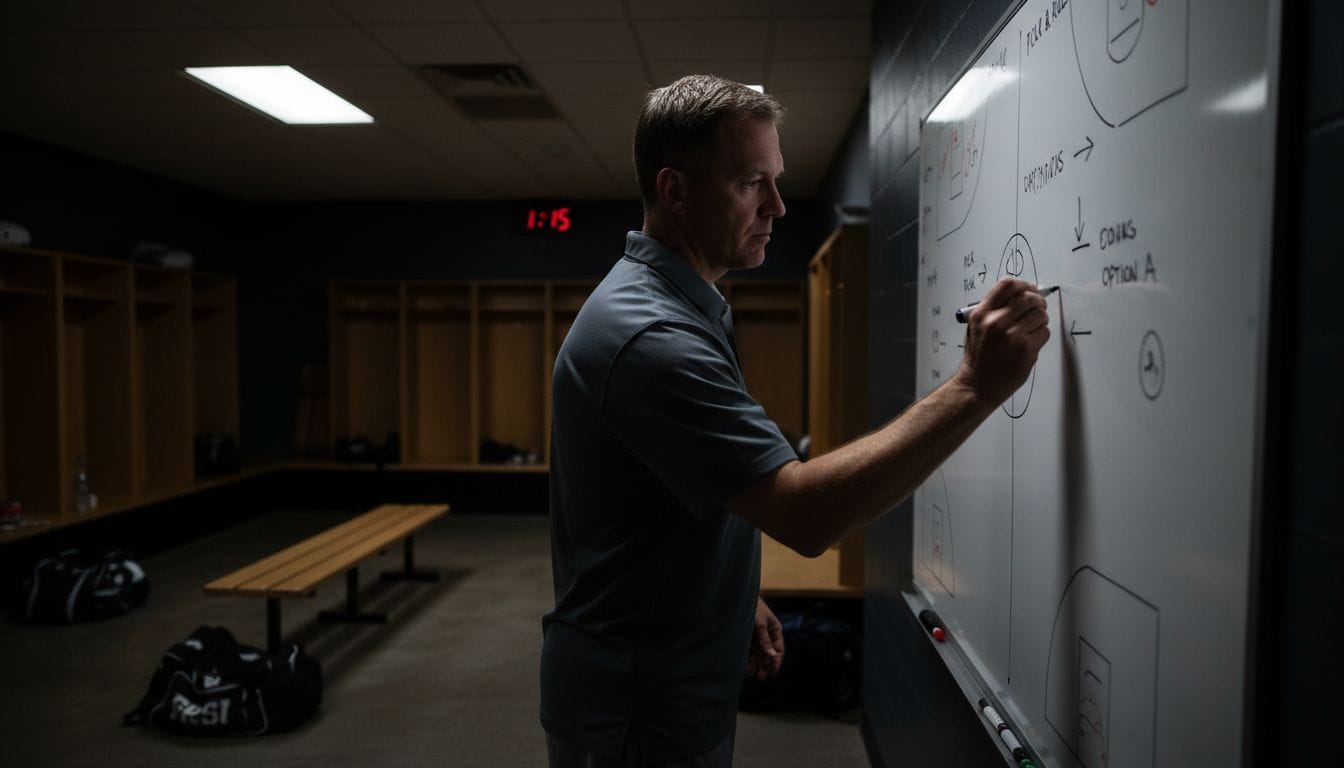
Winning Before the Game Starts: What the "Victory Framework" Reveals About Your Coaching Blind Spots
Most coaches lose before the opening tip. Not because their players aren't talented. Not because their plays are bad. But because they walk into competition without ever having truly prepared to win — they just prepared to compete. When I first heard the quote from Sun Tzu that kicked off this coaching session — "Victorious warriors win first and then go to war, while defeated warriors go to war first and then seek to win" — I had to pause. That hit differently than I expected. Because honestly? I've been the defeated warrior more times than I'd like to admit.
The Question That Exposes Every Coach's Blind Spot
The session opens with a deceptively simple question: is coaching more of an art or a science? And the coach facilitating this cohort is upfront — there's no right answer, but there is a revealing one. Whatever you say exposes your blind spot.
When I heard this, I immediately thought about how I tend to answer. I lean art. I always have. And if I'm honest with myself, that means I've probably been undervaluing the structural, systematic side of coaching for years. The creative, feel-it-in-the-moment instinct gets all my energy. The frameworks, the progressions, the deliberate design of practice? Those get the leftovers.
That's a real problem. Because blind spots — the things we don't even know we don't know — are exactly what derail a team when it matters most. The whole point of the Victory framework being introduced here is that it forces you to zoom out. Almost everything else in coaching asks you to zoom in: this drill, this skill, this moment, this player. The Victory framework asks you to pull back and see the whole picture. That's uncomfortable. It's supposed to be.
This is something I think about a lot — how coaches develop their overall philosophy versus their in-the-moment decisions. If you're genuinely trying to build a complete coaching system, a complete guide to coaching tools is worth sitting with carefully, because the tools you choose reveal exactly what you believe about how basketball should be taught.
The TLC Progression and Why Both Extremes Fail
Before the Victory framework gets introduced, there's a really valuable exchange about what happened the week before — specifically around adversity loads and the TLC progression. The idea is that you load players through three stages: a teaching load (mental), a learning load (reading and decision-making), and a compete load (physical, social, emotional — with a winner and a loser).
One of the coaches in the cohort, Peter, shares something I found genuinely refreshing. He admitted that last season his team looked great in drills and small-sided work but fell apart when it got to five-on-five. Everything that seemed locked in just... evaporated. And the facilitator validates that completely — it's one of the most common failure points in basketball coaching at every level.
What struck me most was how cleanly the problem was framed. You fail at transfer for one of two reasons:
- Too much adversity too soon — you've overloaded players with options and complexity before they've internalized the foundation.
- Not enough adversity — endless block practice against no defense, which feels productive but doesn't transfer to anything real.
Neither extreme works. I've seen this play out personally. You run a beautiful five-on-zero walkthrough and everybody looks like they're on the same page. First live rep? Chaos. That gap between "looks good against air" and "works against a real defense" is where a lot of youth and amateur basketball development quietly falls apart. If you've ever wondered why certain foundational concepts harm youth basketball development instead of helping it, this framing of adversity loads goes a long way toward explaining the mechanism.
The facilitator mentions working with a team that had so many options in their flow offense that players couldn't execute any of them. That's a perfect illustration of cognitive overload masquerading as preparation. More options isn't more readiness — it's more paralysis.
Assuming the Best About Your Players Changes Everything
There's a moment in this session that I keep coming back to. It's not about tactics or frameworks at all — it's about the assumptions coaches make about their players.
The facilitator makes this argument: even if a player genuinely isn't a natural leader, it's still better for you as a coach to assume they are. Because then the responsibility stays with you. You have to find a way to unlock them. The moment you write someone off — they're lazy, they're not athletic, they'll never be a good shooter — you've given yourself permission to stop coaching them. And that's the real failure.
I don't fully agree with this in every scenario, because there are genuine situations where a coach needs to make hard decisions about roles and playing time based on realistic assessment. But the underlying principle? That's solid. The default mode for a lot of coaches — especially under pressure — is to blame the player. The pickleball story the facilitator shares makes it land perfectly: his partner's habit of finding a way to make every lost point his own fault, even when it obviously wasn't, is a form of extreme ownership that most of us only pay lip service to.
This connects directly to something worth reading about if you haven't — the story of a coach who left the NBA to understand basketball from the ground up — because that kind of deliberate humility, that willingness to question your own assumptions, is exactly the mindset being described here.
The compete load isn't just a practice design choice. It's a philosophical one. Getting players into real game situations earlier — five-on-five, with stakes, with a winner and a loser — forces both the players and the coach to confront reality instead of hiding behind controlled conditions. And how you respond to that reality, whether you blame the player or take ownership of the gap, is what separates development-minded coaches from everyone else.
The Victory Framework: Stop Coaching the Scoreboard and Start Coaching the Season
There's a quote from Sun Tzu that completely reframed how I think about coaching, and honestly, about competition in general. "Victorious warriors win first, then go to battle. Defeated warriors go to battle, then seek to win." When I heard this applied to basketball coaching, I immediately thought — how many coaches are doing exactly that? Going into a season without a clear picture of what winning actually means, then scrambling to figure it out mid-game, mid-season, mid-crisis?
The answer, if I'm being honest, is most of us.
The core idea here is deceptively simple: don't coach the scoreboard. Whether you're up twenty or down ten, your coaching philosophy shouldn't shift. Your development priorities shouldn't shift. Because the moment you start reacting to the score, you've already gone to war without a plan to win. You're in survival mode. And survival mode doesn't build programs.
What struck me most was the exercise they walked through live — identifying the one team or rival you need to beat to level up. Not just "we want to be better" in some vague motivational poster sense. Specific. Concrete. What are their strengths? What are their weaknesses? What does your team need to develop to beat them? That's your north star for the entire season. Everything — your practice design, your skill priorities, your defensive principles — should point toward that target.
Peter's example made it click for me. His crosstown rival runs a variety of presses. Phenomenal ones. And yet, when he zoomed out and applied this lens, he and his coach realized that handling and exploiting pressure hadn't been a central theme in their planning at all. A genuine blind spot, exposed in real time. That's the power of this framework. It's not about working harder. It's about working with clarity. I've seen this play out personally — teams that grind through 30 games but never actually close the gap on the program ahead of them, simply because they never asked the right question to begin with.
This connects to something much broader for me. Understanding the full landscape of coaching tools available to modern coaches means knowing that the most powerful tools aren't always drills or plays — sometimes they're frameworks for thinking. The Victory tool is exactly that. And if you don't zoom out before the season starts, you'll spend the whole year reacting to the things that matter least.
Belief, Model, Measure — The Three-Step Framework Every Coach Needs
Once the Victory concept is established, the next question becomes obvious. How do you actually implement it? How do you move your team from where they are to where they need to be? That's where the Belief, Model, Measure framework comes in — and honestly, this is the section that hit hardest for me.
Belief first. Always.
There's a story shared here about a coach who was paralyzed by fear. Fear that players wouldn't buy in. Fear that parents would push back. Fear that an old-school assistant would be uncomfortable. Everything this coach identified as necessary, they immediately second-guessed. And the diagnosis was precise: if you're afraid to teach what you want to teach, you don't believe in it deeply enough yet. Full stop.
I don't fully agree with framing it as "you just shouldn't teach it" if your belief isn't total — because sometimes belief builds through the act of doing, not just before it. But the underlying point is undeniable. Fear and belief cannot coexist at full strength. The deeper your certainty, the less fear can take hold. And that's true for coaches, for players, for parents watching from the bleachers.

This is something I think about a lot when it comes to how the way coaches respond emotionally to their players reveals the cracks in their own belief system. A coach who punishes out of frustration is usually a coach who's lost faith — in the plan, in the players, in the process. Fear-based coaching is almost always belief-deficient coaching in disguise.
The sequence matters here. You can't model something you don't believe in convincingly. And you certainly can't measure growth in a direction you weren't committed to in the first place. Belief isn't just motivational fluff — it's the structural foundation that makes the other two steps functional.
What Coaching With Clarity Actually Looks Like in Practice
Here's where I want to push back slightly on how this framework is sometimes received. People hear "zoom out, coach the season, don't react to the scoreboard" and they interpret it as being passive. Hands off. Just trust the process and everything will work out. That's not what this is saying at all.
Coaching with clarity is still intensely active. You're still making decisions every possession, every practice, every conversation with a player. The difference is that those decisions are grounded in a long-term intention rather than a short-term anxiety response. There's a massive difference between adjusting your press-break emphasis in week three because your identified rival runs elite pressure, versus panicking after a bad loss and overhauling your offense overnight.
One of those is preparation. The other is chaos dressed up as coaching.
What this framework demands is that you've done the homework before the season begins. You know the team. You know the blind spots. You've built your belief in the method. And then, every practice, every game, every timeout becomes a data point — not a verdict. Did we handle pressure better today than we did last week? That's the question. Not "did we win?" Those are completely different questions, and conflating them is how programs stagnate.
I've watched coaches who are brilliant tacticians but terrible at helping players make faster, better decisions under pressure — and often it traces back to this exact problem. Practices built around avoiding mistakes rather than building confidence. Fear-based design. No wonder the players freeze when it matters.
And if you want a concrete example of what this clarity looks like at the elite level, think about how a coach who deliberately stepped away from the NBA to rebuild their understanding from the ground up redefined their entire coaching philosophy — not by adding complexity, but by stripping back to what they actually believed in. That's the Belief step in action. Real, earned, tested conviction. Not borrowed certainty from a playbook someone else wrote.
The Victory framework isn't a shortcut. It's a lens. And once you start seeing through it, it's genuinely hard to go back to scoreboard-reactive coaching — because you can see, clearly, how much it costs you.
Every Coach Is a Salesperson — And Belief Is Your Product
When I heard this, I immediately thought about every practice I've ever seen where a coach just barks an instruction and expects instant buy-in. That's not how humans work. That's not how any of this works. And yet we do it constantly.
The line that hit me hardest was simple: every coach is a salesperson. Not occasionally. Not in big moments. All the time. And like any good salesperson, if you don't believe in what you're selling, nobody's buying. Full stop.
The door-to-door sales story blew me up a little. Six months knocking on doors in Southern California trying to sell home security systems. If he didn't believe it was a good deal? They didn't believe it was a good deal. That's the whole thing. That's coaching in one sentence. You can run the most technically sophisticated session in the world, but if your players don't believe it's going to make them better — and more importantly, if you can't tell them why it's going to make them better — you'll get eye rolls, half effort, and zero execution when it matters.
I've seen this play out personally. A coach I know used to open practice with the same tired drills every single session. Players went through the motions. Nobody was locked in. The problem wasn't the drills. The problem was nobody had ever explained why those drills existed. There was no belief. No story. No data. Just "we've always done it this way." And that's the most dangerous sentence in coaching.
The three-man weave example is genuinely one of the better moments in this whole conversation. A coach tells him they should spend 90 minutes on three-man weave. He asks why. The answer? "Because we've always done it." That's it. No data. No outcome. No belief system. Just habit masquerading as method. And when you have a better alternative to three-man weave that actually transfers to the game, there's genuinely no excuse to keep defaulting to something no one can defend with evidence.
Then he flips it. Serbian passing. Same skill set — running, passing, catching. But before he even explains the drill, he drops this: Luka Dončić has been doing Serbian passing with his national team since he was 14, and Luka says it's what built his vision and creative passing ability. Do you want to try it? Of course they do. That's belief built in thirty seconds. Not because of the drill itself, but because of the story attached to it. Because of the data. Because of the connection to someone every player in that room respects. If you've ever wondered how Luka plays so slowly yet still destroys everyone, well — this is part of the answer. His foundation was built with intention, with belief, with purpose behind every rep.
This is something I think about a lot. Belief isn't soft. It's not the touchy-feely part of coaching you do before you get to the real stuff. It IS the real stuff. It comes first. It takes the longest. And most coaches skip it entirely because they're impatient, or because they themselves don't actually have the data to back up what they're asking players to do.
And that's uncomfortable. Because it means the effort problem you think you have is actually a belief problem. The execution problem you're frustrated by? Belief problem. The player who won't buy into the system? You haven't given them a reason to believe in it yet. That's on the coach, not the kid.
Being Data-Driven Isn't Just for Analytics Departments
The second major thread here was about becoming more data-driven. And I want to push back slightly on how people tend to hear that phrase — because most coaches immediately think "I don't have access to that kind of data." And that's true at the youth or community level. But that's not what was being said here.
Three ways to be more data-driven. One: research at the highest levels. NBA, WNBA stats, percentages, tendencies. That data exists and it's free. Use it. Two: measure more in your own practices and games. You don't need a full analytics department — you just need to start counting things intentionally. Three — and this is the one I loved most — ask others to build a case against you.
Tell a player they're not starting. Then ask them to come back in a week with a case for why they should. That's genius. Not because it's a management trick, but because it forces both sides to think clearly. Either the player can't build the case and the decision stands with no resentment, or they build a case so compelling it changes your mind — and now you've made a better decision. Either outcome is a win. And as someone who's spent time thinking through what the complete landscape of modern coaching tools actually looks like, this kind of structured decision-making process is exactly the kind of thing that separates good coaches from great ones.
What struck me most was how honest this makes the whole thing. When we say "I trust my eyes," we're really saying "I don't want to be challenged on this." And sometimes our eyes are right. But sometimes they're not. And the coaches who build great programs over time are the ones who are willing to be wrong, willing to be challenged, and willing to let the data change their mind.
The player conversation about looking like a threat before catching the ball — that small exchange at the end of this session was deceptively deep. The coach said he wants his players to believe they are a threat, not just that they should look like one. That distinction matters enormously. You can fake body language. You can't fake genuine belief in yourself. And to build that real belief? Players need to see improvement. They need the ball going in. They need measurable progress. Which means the coach needs a process, a measurement system, and the patience to let belief develop over time.
I don't fully agree with everything in this session — I think the idea of building belief can sometimes become an excuse for slow implementation, and some players actually need to just be thrown into the fire before they'll believe anything. But the core framework? Hard to argue with. Data builds belief. Belief drives effort. Effort produces execution. And execution — over time, with the right foundation — becomes winning. That's the chain. And too many coaches are trying to start at the end of it.
Test Your Basketball IQ!
Beat the clock! 5 questions, 14 seconds per answer, 2:00 game clock. Can you get a perfect score before time runs out?

Put your knowledge to use
CourtClok keeps score, tracks player stats, and lets your fans follow along live — all from your phone. Free for any league or pickup game.